Speaker Spotlight Series: Pioneers Shaping IO Biomarker Science
ImmunoMark Summit | UK Edition 2026 | London
ImmunoMark Summit is the global conference series at the intersection of Immuno-Oncology and Biomarker Discovery. Conceptualized and curated by Convolign Business Consulting.
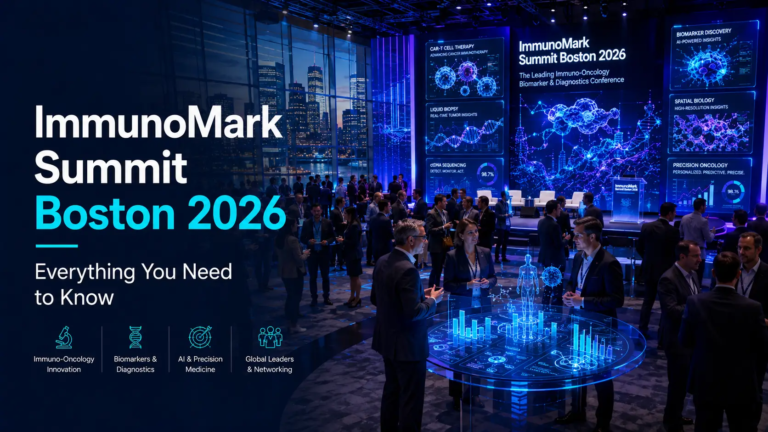
When the ImmunoMark Summit touched down in London on 5–6 March 2026, it brought together over 400 scientists, executives, and innovators at the DoubleTree by Hilton, Tower of London. Two packed days. Two parallel streams. And a room full of people who are actively shaping where immuno-oncology and biomarker science go next.
One of the things that makes ImmunoMark Summit stand out is the calibre of the people it puts on stage. We sat down with three of the summit’s keynote speakers to understand what drives their work, what they shared with the audience in London, and what they believe the field needs most right now.
Key takeaways
- Biomarkers are the connective tissue of modern IO. Across discovery, clinical development, and commercial strategy, every speaker at ImmunoMark Summit London 2026 pointed to biomarkers as the thread that holds the whole enterprise together.
- The field’s biggest challenge is integration, not invention. The science of biomarker discovery has matured. What needs work is how biomarker data flows across functions, from the lab into clinical decisions and from clinical evidence into market access strategy.
- Precision only pays off when it starts early. Programs that build companion diagnostic thinking in from day one outperform those that treat it as a downstream task. That was a shared conviction across all three profiles in this piece.
- ImmunoMark Summit is where this conversation happens across silos. Bringing together a CSO from biotech, a VP from a global pharma bioanalysis function, and a commercial franchise head onto the same agenda is exactly the kind of cross-functional alignment the field needs more of.
“The target was right in front of us”
A conversation with Dr. Louis Boon, CSO, JJP Biologics
Dr. Louis Boon has spent decades in biologics, working across some of the most formative chapters in monoclonal antibody development. Today, as Chief Scientific Officer and Management Board Member at JJP Biologics, a Polish biotech backed by the Starak family, he is focused on what he calls a fundamentally overlooked checkpoint pathway.
His keynote opened Stream 01 (Next-Gen Immuno-Oncology) and centred on JJP-1008, a novel checkpoint inhibitor antibody targeting HVEM, also known as CD270. The regulatory interactions at this receptor have long been recognised in immunology, but their therapeutic potential in oncology is only now being properly explored.
What brought you to this target?
“Most checkpoint programs go after well-validated targets. We asked a different question: where is high tumour expression actually working against the patient? HVEM is one of those targets. High CD270 expression is generally disadvantageous for the patient. JJP-1008 is designed to flip that and convert the tumour’s advantage into an immune-stimulatory benefit.”
The science is precise. By selecting the right anti-CD270 antibody, the team at JJP Biologics is aiming to turn a known liability into a clinical opportunity, in both solid tumours and haematological malignancies.
What does the companion diagnostics piece look like?
“We build our programs around companion diagnostics from day one. That is how you select the right patients. It is how you reduce development costs and increase the chance of success. Biomarker strategy and therapeutic strategy should not be separate conversations.”
This is a principle JJP Biologics holds across its pipeline, which also includes JJP-1212, a potential first-in-class CD89 antagonist for autoinflammatory diseases. Both programs are anchored in early companion diagnostic selection, a discipline that resonates strongly with the ImmunoMark Summit community.
Dr. Boon holds a PhD in Biochemistry from the University of Amsterdam and has founded or co-founded multiple companies focused on therapeutic monoclonal antibodies. He has held CSO roles at Polpharma Biologics, Bioceros, 4AZA Bioscience, and others. For someone with that kind of track record, the conviction he brings to JJP’s work feels earned.
What do you hope the audience took away from London?
“That novel biology is still out there. You do not always need to go after the same targets. Sometimes the most interesting opportunity is hiding in plain sight, in a pathway everyone knows but no one has fully worked on.”
“Biomarkers have to drive decisions, not just describe them.”
A conversation with John Smeraglia, VP Head of Global Integrated Bioanalysis, AstraZeneca
John Smeraglia gave the keynote for Stream 02 (Biomarkers & CDx) and the title of his talk told you everything about his perspective: biomarker strategy as a clinical decision-making tool.
Smeraglia is based in Cambridge and leads global integrated bioanalysis at AstraZeneca, one of the world’s most biomarker-forward oncology organisations. He has spent over 26 years working in bioanalytical sciences, first in the US and then across the EU, at both innovator drug development companies and CROs. His background spans ADME, pharmacokinetics, immunogenicity, and translational biomarker development. Before joining AstraZeneca, he served as Senior Director of Translational Biomarkers and Bioanalysis at UCB.
Where do you see the biggest gap in how biomarkers are used today?
“The problem is not always the science. It is how biomarker data gets used. You can have a well-validated assay and still have biomarker findings that do not meaningfully influence the trial. That gap, between what the biomarker tells you and how teams actually act on it, is where I spend a lot of time.”
His work at AstraZeneca reflects this focus. The organisation has invested heavily in computational pathology, including a fully automated solution called Quantitative Continuous Scoring, which goes beyond detecting the presence or absence of a biomarker to measuring its expression level and localisation within cells. The goal is to make biomarker output richer, more actionable, and better integrated into clinical decision-making.
How do you approach the selection of the right biomarker and analytical method for a given study?
“It starts with the biology and the mechanism. What are you actually trying to measure, and why? Then you work backward to the assay. You have to ask yourself whether this biomarker will tell you something you can act on. If the answer is no, you need a different biomarker.”
Smeraglia has published on and contributed to workshops on regulated bioanalysis, biomarker assay validation, and immunogenicity. He has been a consistent voice in industry efforts to harmonise how biomarker data is generated and reported. That cross-industry perspective was evident in how he framed the London discussion: not just as an AstraZeneca problem to solve, but as a shared challenge for the whole field.
What is the question you keep coming back to?
“Are we building biomarker programs that tell us something we already believe, or ones that can genuinely surprise us? If it is the former, we are confirming hypotheses. We need to be in a place where biomarker data can challenge assumptions and change the course of a trial.”
“Biomarkers are a market-making force, not a footnote.”
A conversation with Yariv Hefez, SVP Head of Global Business Franchise Oncology, Merck Group
If anyone in the room understands the commercial weight of a well-chosen biomarker, it is Yariv Hefez. As Senior Vice President and Head of Merck’s Global Business Franchise for Oncology, he has led the strategy behind therapies like Bavencio, Erbitux, and Tepmetko and has spent more than 23 years navigating the intersection of oncology science and global commercial execution.
At ImmunoMark Summit London, Hefez moderated the landmark panel discussion that closed the Biomarkers & CDx stream: Biomarkers as Market-Makers in Oncology. The panel brought together voices from J&J and Roche, and the conversation covered how biomarker-driven patient stratification shapes not just clinical outcomes but commercial strategy, market access, and reimbursement.
How did the idea of biomarkers as “market-makers” land with the room?
“People know biomarkers are scientifically important. What we do not always talk about is the commercial dimension. A strong biomarker that lets you identify who will respond to your drug is not just good science. It is a competitive asset. It is how you build a durable treatment franchise.”
Tepmetko is a clear example of this thinking in practice. The drug targets patients with MET exon 14 deletion non-small cell lung cancer, a rare variant precisely identified through a biomarker, and that precision is exactly what makes it viable both clinically and commercially. As Hefez put it, “the beauty of Tepmetko is that we have such a good biomarker that allows us to know who is going to benefit.”
What do you think is still missing in how the industry approaches biomarker strategy commercially?
“There is still a tendency to treat biomarker development as a scientific activity that happens upstream and then feeds into commercial strategy. The most successful programs are the ones where commercial, market access, and science are aligned from the beginning. Biomarker strategy should not be handed off. It should be co-owned.”
Hefez has built a reputation as someone who brings market access into the room early and holds it there. Under his leadership, Merck’s oncology franchise has grown significantly, with launches that required not just scientific rigour but a deep understanding of health economics and reimbursement systems across global markets.
What is the broader signal the field should take from conversations like this one?
“That the era of treating biomarkers as optional add-ons is over. If you are developing a drug without a clear biomarker story, you are going to find it harder to get reimbursed, harder to get prescribers on board, and harder to compete. Biomarkers are not a nice-to-have. They are the foundation.”
What the room said back
The post-event survey data from ImmunoMark Summit London 2026 shows an audience that felt the programme delivered. Sponsors from organisations including Miltenyi Biotec, Rouken Bio, and HAWK Biosystems commented on the quality of the scientific discussions and the calibre of attendees. The event drew professionals across pharma, biotech, academia, hospitals, and CROs, roughly 60% from the UK and Ireland and 40% from the rest of Europe.
The Biomarkers as Market-Makers panel, in particular, drew strong engagement. Moderating a cross-industry conversation between speakers from Merck, J&J, and Roche in front of a senior audience is no small task, and Hefez’s ability to hold the room while drawing out commercially candid perspectives was widely noted.
The two parallel streams, Next-Gen IO and Biomarkers & CDx, ran simultaneously across both days, letting attendees build a focused, relevant programme for themselves. Sessions ranged from CAR-T multi-antigen targeting for solid tumours to AI-driven PD-L1 standardisation, extracellular vesicle profiling, and home-sampling biomarkers.
All three agree: biomarkers cannot stay siloed
Three speakers. Three organisations. Three different entry points into the same problem.
| Speaker | Organisation | Core Focus at London 2026 |
| Dr. Louis Boon | JJP Biologics | Novel checkpoint biology anchored in companion diagnostics |
| John Smeraglia | AstraZeneca | Translational biomarker strategy as a clinical decision driver |
| Yariv Hefez | Merck Group | Biomarkers as commercial and market-access assets |
What they share is a conviction that biomarker science cannot remain siloed. Whether you are working in early discovery, clinical bioanalysis, or global commercial strategy, the decisions you make about biomarkers have consequences far beyond your immediate domain. That is exactly the kind of cross-functional thinking ImmunoMark Summit was designed to encourage.
The next chapter
The UK edition is now concluded. But the conversation continues.
ImmunoMark Summit is coming to Boston, bringing the same standard of scientific and commercial dialogue to the US East Coast. If London is any indication, the Boston edition will be another forum where the people shaping precision oncology can speak openly, think across functions, and build the connections that move the science forward.
Follow ImmunoMark Summit for updates, or register for the Boston edition now.
#Biomarkers
#CancerResearch
#ClinicalTrials
#IOConferences